Pegana — the peg-risk oracle for Solana.
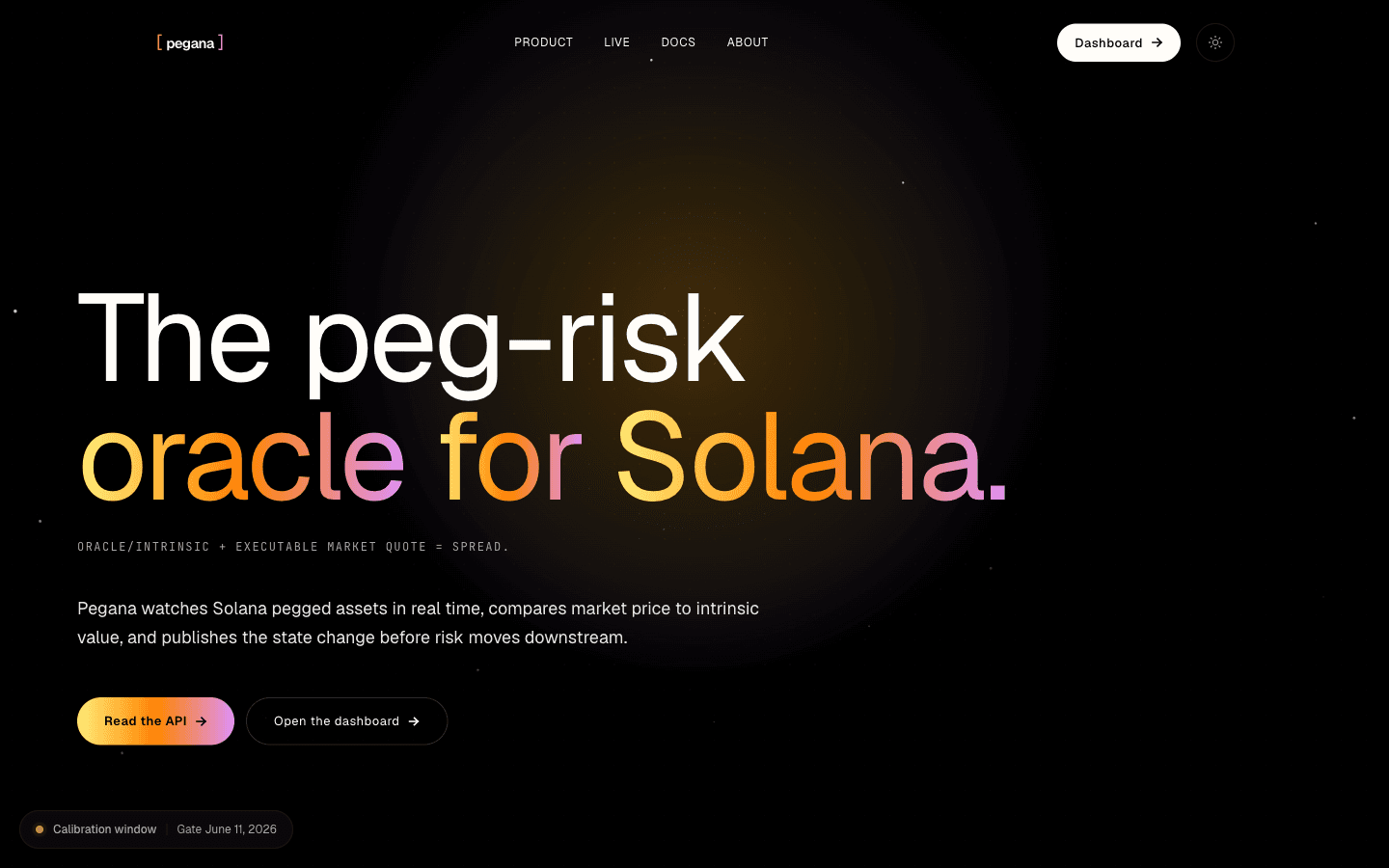
Pegana is a peg-risk oracle for Solana, an early-warning system that measures the gap between an asset's intrinsic value and its executable market price, flagging deviations before risk moves downstream. It tracks 22 pegged assets, from liquid staking tokens to stablecoins, and publishes every state change across five surfaces: REST, WebSocket, MCP, webhooks, and Telegram. The whole system runs on a Rust microservice pipeline with a public, reproducible Trust Layer. Alpha on mainnet.
Overview
Pegana is a peg-risk oracle for Solana. It compares each asset's intrinsic value with the market price at which it can actually be executed, computes the spread between the two, and publishes the resulting state change before the risk moves downstream. It currently monitors 22 pegged assets on mainnet across six classes, spanning liquid staking tokens, stablecoins, yield-bearing assets, and synthetics. Every asset is classified by a five-state machine: PEGGED, DRIFT, DEPEG, CRITICAL, and UNKNOWN.
The challenge
Peg risk is hard because the quoted price rarely matches the price at which you can actually exit a position, and small deviations can turn into contagion before they show up on any dashboard. A raw signal flickers and produces false alarms; a signal that is too slow warns too late. Pegana measures the spread, smooths it with an exponential weighted moving average, and applies per-asset thresholds with asymmetric hysteresis, so noise does not become an alert and real movement is not missed. Each class reads from a single source with no price blending, which keeps the origin of every data point traceable.
Outcome
The system runs in alpha on Solana mainnet, on a pipeline of Rust services with a TypeScript layer, and publishes every state change across five channels: REST, WebSocket, MCP, signed webhooks, and a Telegram bot. MCP access is paid through x402 and aimed at agents in Claude, Cursor, and Cline. All of it sits on a public Trust Layer: every parameter, from threshold to dwell time, is version-controlled in open configuration with no black-box logic, so anyone can reproduce a state from raw inputs.